
Why Consistent Branding Photography Increases Sales
Tue Aug 2026

Category:
When customers encounter your business online, they form an impression before they read your carefully written copy, compare your services or speak to your sales team. Photography plays a significant role in that first impression.
For entrepreneurs and SMEs, this creates an often-overlooked opportunity: consistent branding photography can make your business look more credible, recognisable and trustworthy which can influence whether someone chooses to enquire, buy or move on.
It is not simply about having attractive photographs. The real value comes from creating a visual identity that customers recognise across your website, LinkedIn profile, social media, presentations, email campaigns and other marketing channels.
What is consistent branding photography?
Brand photography is best described as the collection of professional images used to represent a person, company, team, products, services and the people behind the business.
Consistency means those images share a recognisable visual language.
That could include similar:
- Lighting and image quality
- Colour treatment
- Backgrounds and environments
- Composition
- Clothing and styling
- Posing and expressions
- Professional tone
- Use of brand colours and visual elements
The objective is not to make every photograph look identical. Instead, the images should feel as though they belong to the same business.
This distinction matters.
A company might have an excellent headshot, a casual smartphone photograph on LinkedIn, an outdated team photograph on its website and completely different imagery on social media. Each image may be acceptable individually, but collectively they create a fragmented brand experience.
Why visual consistency builds trust
Trust is fundamental to conversion.
Before somebody contacts an accountant, consultant, estate agent, financial adviser, coach or other professional, they are often asking themselves a simple question:
“Does this business look credible enough to trust?”
Professional photography cannot guarantee a sale, but it can remove unnecessary doubt.
When your visual presentation is consistent, customers receive repeated signals that the business is established, organised and intentional about how it presents itself.
This is particularly important for SMEs competing against larger businesses.
You may not have the marketing budget of a multinational company, but a coherent visual identity can help create a comparable level of professionalism.
Your photography becomes part of the evidence supporting your brand promise.
Recognition matters more than another pretty photograph
One of the biggest advantages of a consistent image library is recognition.
Customers rarely see your business once and immediately make a purchasing decision. They may encounter you on LinkedIn, visit your website, see a social post several days later and eventually return to make an enquiry.
If the visual style remains recognisable throughout that journey, each exposure reinforces the previous one.
This is where visual branding becomes commercially useful.
Your audience begins to associate particular photographic characteristics with your business. Over time, that familiarity can make your content easier to identify in an increasingly crowded digital environment.
Consistency therefore isn’t about aesthetics alone. It supports brand recall.
The connection between photography and conversion
Conversion rate optimisation (CRO) is often associated with landing-page layouts, calls to action, forms and website performance.
But the visual experience surrounding those elements matters too.
Imagine two professional services websites.
The first has polished, consistent portraits of its team, photographs that reflect the company’s working environment and imagery that supports its positioning.
The second uses a mixture of old staff photographs, inconsistent headshots, stock photography and casual mobile-phone images.
The service offered by both companies might be equally strong.
Yet the first business has done more to reduce visual friction.
A visitor can more easily understand who they are dealing with, what the business represents and whether it appears established.
That matters because every unnecessary point of uncertainty can create resistance before a prospect takes the next step.
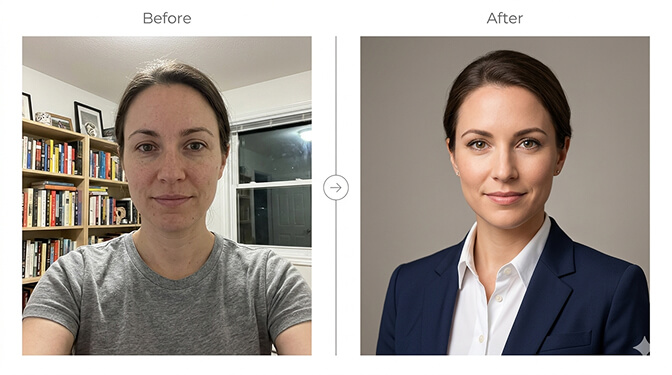
From inconsistent to intentional
Before:
Different headshot styles, mixed backgrounds, inconsistent lighting and photographs taken years apart.
After:
A coordinated set of portraits using a consistent visual approach, suitable for websites, LinkedIn profiles, proposals and marketing campaigns.
Your people are part of your brand
For many SMEs, the people behind the business are the brand.
Clients want to know who they are dealing with. A professional headshot can make an individual feel more approachable and credible, particularly when the service involves expertise, advice or personal interaction.
This is why a branding session should go beyond producing one formal head-and-shoulders portrait.
A well-planned session can create a useful library of images:
- Professional headshots
- Environmental portraits
- Working images
- Informal but professional photographs
- Team interactions
- Detail shots
- Images suitable for social media
- Website banner and campaign imagery
Instead of repeatedly asking, “What photograph should we use?”, your business has a bank of relevant visual assets ready for different marketing requirements.
Consistency makes your marketing easier
There is another commercial benefit that is often overlooked: content production becomes easier.
Without a suitable image library, businesses often resort to stock photography or repeatedly use the same headshot.
Neither approach necessarily reflects the personality or expertise of the company.
A planned branding photography session can provide months of usable content.
Your website can use one set of images. LinkedIn can use another. A new service announcement can use another. Your team member can have an appropriate professional photograph for a speaking engagement or media opportunity.
This creates consistency while giving your marketing enough variety to remain interesting.
For businesses using LinkedIn as a lead-generation channel, this is particularly valuable. Your profile and company content should look as though they come from the same professional brand rather than a collection of unrelated posts.
You can also use LinkedIn as part of a broader professional presence where consistent photography supports recognition across your personal and business profiles.
What should a branding photography session achieve?
The starting point should not be “How many photographs do we need?”
The better question is:
“Where will these images be used, and what do we want customers to think when they see them?”
Before a session, consider:
- Who is your ideal customer?
- What should your brand communicate?
- Where will the photographs appear?
- Do you need individual, team and environmental images?
- What services or products need visual representation?
- What existing brand colours and design elements should influence the photography?
- How much content will you need over the next six to twelve months?
This approach turns a photography session into a marketing asset rather than simply another photoshoot.
Consistency does not mean being boring
There is an important distinction between consistency and repetition.
Your photographs should feel connected, but they do not need to look like copies of one another.
A strong visual system can accommodate formal portraits, relaxed workplace photographs, detail shots and more dynamic marketing imagery while maintaining a common aesthetic.
Think of it as creating a visual family. The photographs can be different individuals, locations and compositions while still being immediately recognisable as belonging to the same brand.
How to know whether your photography is working
Photography should ultimately support business objectives. While it is difficult to attribute a sale to one photograph in isolation, you can assess whether your visual presentation is improving the customer journey.
Look at indicators such as:
- Website engagement
- Enquiry rates
- Landing-page conversions
- LinkedIn engagement
- Profile visits
- Time spent on key pages
- Quality and volume of enquiries
- Performance of campaigns using new imagery
Compare content before and after introducing a more consistent visual approach where possible.
The objective is not to claim that photography alone caused an increase in revenue. Instead, look at how improved visual communication contributes to the overall marketing system.

A consistent visual identity is a business asset
For entrepreneurs and SMEs, professional photography should not be treated as a once-off exercise whenever an old headshot becomes embarrassing.
Your business changes. Your team changes. Your services develop. Your positioning evolves.
Your photography should evolve with it.
A consistent visual library gives your marketing a stronger foundation, helps customers recognise your business and gives your brand a more credible presence wherever prospects encounter it.
If your website, LinkedIn profile and marketing materials currently look as though they were created by three different businesses, it may be time to review your visual identity.
A professional branding session can give you more than a new professional headshot. It can give your business a coordinated collection of images designed to work together across your marketing.
Frequently Asked Questions
Does consistent branding photography really increase sales?
It can contribute to stronger conversion performance by improving credibility, recognition and the overall customer experience. Photography is one part of the conversion process rather than a standalone guarantee of increased sales.
How often should a business update its branding photographs?
There is no universal timetable. Businesses should consider updating their imagery when their team, appearance, services, positioning or visual identity changes. Many companies benefit from planning photography periodically so their image library remains current.
What is the difference between a headshot and branding photography?
A headshot primarily represents an individual. Branding photography is broader and can include portraits, workplace images, team photographs and other visual assets designed to communicate the character and positioning of a business.
Why is visual consistency important for small businesses?
Consistent imagery can make a smaller business appear more established and professional while helping customers recognise it across different marketing channels. It also makes content creation easier because the business has a suitable library of branded images available.
Can professional photography improve website conversion rates?
Potentially, yes. Strong imagery can support credibility, communicate information quickly and reduce uncertainty. However, conversion performance also depends on factors such as the offer, messaging, website usability, pricing, audience and call to action.
What photographs should an SME include in a branding session?
A useful image library may include professional headshots, environmental portraits, team interactions, working photographs and images suitable for websites, social media, presentations and campaigns. The right combination depends on the business and its marketing strategy.
How does branding photography support LinkedIn marketing?
Consistent professional imagery helps connect your personal profile, company page and content visually. When people repeatedly encounter recognisable photographs and a coherent visual style, it becomes easier for them to associate the content with your business.
Should every photograph use the same background?
No. Consistency does not require identical backgrounds. A stronger approach is to maintain a consistent visual direction while using different locations, compositions and situations to create variety.
What is the biggest mistake businesses make with professional photography?
One common mistake is treating photography as a single image purchase rather than a content asset. A strategically planned session should consider where the photographs will be used and create enough variety to support the business’s marketing needs.
Key Takeaway
Consistent branding photography is not about making your business look polished for the sake of appearances. It is about making your visual communication clearer, more recognisable and more trustworthy at every stage of the customer journey.
When your photography works together across your website, LinkedIn and marketing channels, every image has the opportunity to reinforce the same brand message, helping prospects recognise you, understand you and feel more confident taking the next step.